Warehouse Consolidation vs Storage for 1688 Orders
Compare warehouse consolidation vs storage for 1688 orders, including holding decisions, approved packing work and inbound-to-outbound traceability.
The short answer
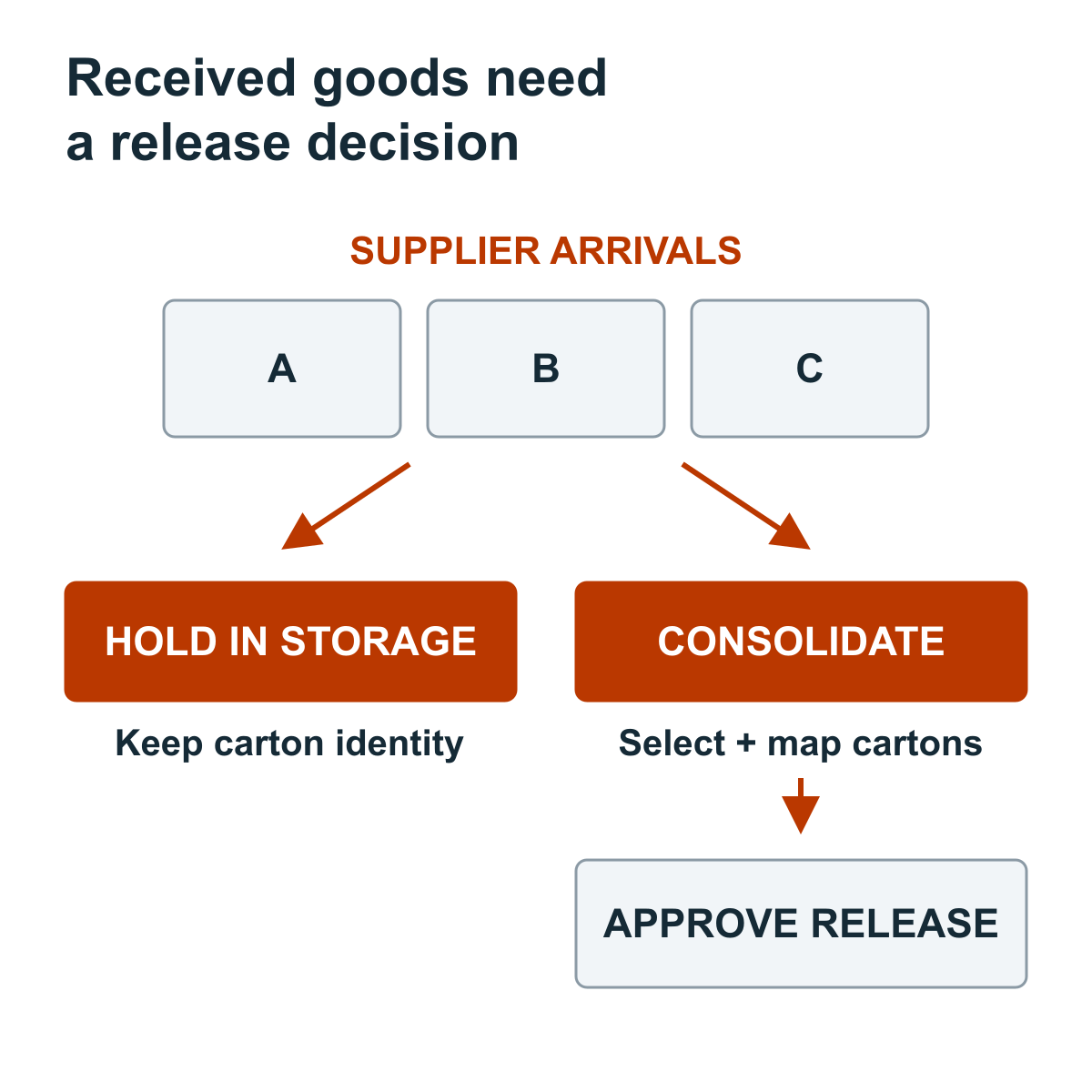
Storage keeps received goods available until a later instruction. Consolidation prepares selected goods for a combined release. One is a holding decision; the other changes the outbound grouping and may require handling or packing work.
In this article
| Activity | Main decision | Information to retain |
|---|---|---|
| Storage | What to hold and until when | Arrival, duration and charge basis |
| Consolidation | Which received goods leave together | Inbound-to-outbound mapping |
| Repacking | What packaging may change | Approval and final packed measurements |
Receiving does not automatically authorize consolidation
A supplier parcel can be received and identified without being unpacked or combined with other goods. Tell the warehouse which decisions are already approved and which should wait for your instruction. A delivery scan alone is not a packing instruction.
Create a supplier list with order references, expected cartons and domestic tracking numbers. Mark split deliveries separately. You need to know which goods have arrived before choosing what to hold, combine or release. Otherwise a missing parcel can be mistaken for a completed supplier order.
Keep a holding plan for staggered arrivals
Suppose two suppliers have arrived but a third is still preparing the order. Storage may allow you to wait, but the decision has a duration and a cost. Ask when storage time begins, what unit is charged and what event ends the charge. Keep estimates separate from a confirmed fee schedule.
Waiting may make sense when the goods need to leave together. It may be less useful when one product is urgent or one seller has an uncertain ready date. Set a review date and a clear release instruction rather than leaving the warehouse to infer how long it should hold everything.
Consolidation is a physical scope, not just a new label
A combined release could mean several existing cartons leaving under one instruction, or it could involve opening, sorting and repacking their contents. Those are different amounts of work. Specify what may be opened, whether retail packaging must remain and how goods from different sellers should be identified afterwards.
Ask for the proposed final carton count and packed measurements when relevant. A consolidated arrangement can reduce unnecessary empty space, but it can also add labour or protective material. Do not assume a combined shipment will be smaller or cheaper until its packing plan is known.
Preserve identity through the change
The useful record connects each inbound carton to the items or outbound cartons created from it. GS1’s logistics-unit identification guidance describes the broader principle of linking a physical unit to its electronic information. That principle is useful even when your service uses its own internal carton references rather than GS1 labels.
Ask how your warehouse will show the connection after repacking. A list of seller names is not enough if several cartons contain similar products. Keep photos tied to identifiers, and resolve disputed quantities before approving a packing change that mixes the goods.
Use a release decision with explicit boundaries
Write down the cartons to include, cartons to keep on hold, approved packing work and the person who must approve any variation. If a late parcel arrives after the release has been prepared, it should trigger a decision rather than silently being added to an already agreed load.
Our receiving brief lets you share supplier and arrival information, with optional photo and packaging requirements. Use it to establish the receiving scope first. Request consolidation or repacking as specific work and review the resulting charges and release instructions before authorizing dispatch.
A three-supplier receiving decision
Supplier A has delivered two cartons, B has delivered one, and C is still preparing its order. You have three received cartons, not necessarily a complete three-supplier order.
- Keep A1, A2 and B1 visible in the receiving list and mark C as outstanding. Decide whether the received cartons should wait for C or whether a partial release better fits your need.
- If waiting, confirm the storage start event and charge basis for each arrival. Set a review date; do not leave the warehouse to interpret an indefinite instruction such as “combine everything later”.
- If consolidating, list the exact included carton references and approved packing changes. Ask for a mapping from A1/A2/B1 into the proposed outbound units and confirm any new packed measurements.
- If C arrives after packing starts, request a decision about the new parcel. Do not assume it can be added to a previously approved release without changing the instructions.
The final record should show what remains on hold, what changed during packing and what was approved for release. That record is useful whether the goods stay in their original cartons or are repacked.
Put this into your request
Request warehouse receiving using your actual goods, destination and known shipment details. Our team can review the missing information and the next step.
Common questions
Does storage include repacking?
Not automatically. Confirm the included work and request a separate scope for opening, sorting or repacking.
Will consolidation always reduce shipping cost?
No. Compare the final packed shipment and handling charges. Combining parcels is not itself evidence of a lower total cost.
References
Sources checked for this edition on 2026-11-08. Service offers and carrier rules can change; confirm the terms for the shipment you intend to send.
