Warehouse Photo Check vs Product Inspection: What Can You Actually Verify?
Compare a warehouse photo check with a defined product inspection, and write a useful evidence request for your 1688 arrivals.
The short answer
A warehouse photo records what is visible at an agreed point in receiving. A product inspection evaluates defined characteristics under an agreed scope. A few photos cannot establish every unit’s quality, function or regulatory compliance.
In this article
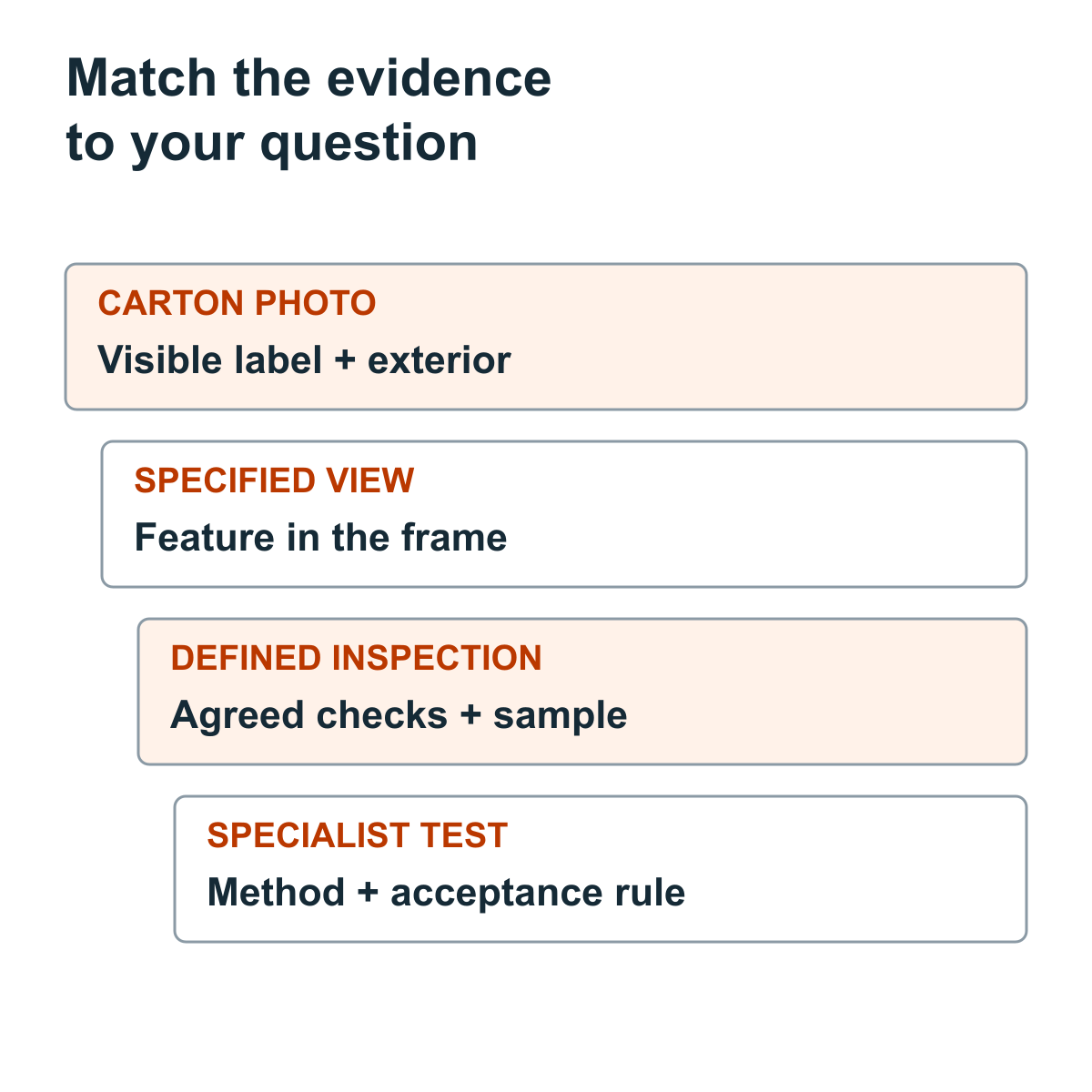
| Request | Can help establish | Does not by itself establish |
|---|---|---|
| Carton photo | Visible label and exterior condition | Every item inside is correct |
| Specified product view | A visible feature in the frame | Whole-batch quality |
| Defined inspection or test | Results under its stated method | Unrelated compliance or untested characteristics |
Start with the question you need answered
“Please do QC” is too vague to define an outcome. Do you need to know whether the carton label matches the seller, whether a visible colour looks correct, whether all listed units are present, or whether a product functions under a specified test? Each question requires different access, time and evidence.
Separate obvious receiving observations from checks that require opening retail packaging or operating the product. Ask the warehouse what is included in the receiving service and what needs a further quote. Agree whether destructive or irreversible work is permitted before anyone removes a seal or changes packaging.
Make a photo request that can produce useful evidence
Specify the carton reference, the feature to photograph and the reference against which you will review it. A label close-up and an overview of the visible contents answer different questions. If a size marking matters, request a readable image of that marking rather than a distant picture of the carton.
Keep the resulting images connected to the receiving record. Similar-looking cartons can arrive from different sellers on different days. Without identifiers, a perfectly clear photograph may still be insufficient to establish which order or parcel it describes.
Recognise the limits of a visible check
A photograph can show a visible condition in its frame. It cannot establish what is outside that frame, inside sealed packaging or true of every other unit in a batch. Lighting and screens can also affect colour judgement. Treat a useful photograph as evidence for its specific question, not as a blanket product certificate.
A count, dimensional check or functional test needs its own method and acceptance criteria. SGS’s description of pre-shipment inspection illustrates that professional inspection can encompass several distinct checks. It does not mean that an ordinary warehouse receiving service includes that entire scope or provides equivalent certification.
Decide what happens when a discrepancy is found
Write an instruction for affected goods: hold the identified carton, provide the requested evidence and wait for your decision. Tell the team whether unaffected cartons may continue through the agreed process. A clear hold instruction reduces the chance that disputed goods are repacked or released before you can review them.
If the issue concerns supplier performance, retain the original order description and the evidence needed for that discussion. The warehouse can record observations under its agreed scope, but an observation alone does not determine the seller’s contractual liability or the outcome of a return request.
Request specialist work when the decision requires it
Products with safety-critical performance, technical tolerances or particular compliance requirements may need a qualified inspection or testing provider and a product-specific procedure. State the requirement before the goods arrive and ask who is qualified to perform it. Do not substitute a general “passed QC” note for the report you actually need.
On our receiving request, describe the photo views and packaging permissions in the optional requirements. If you need more than a basic visible check, name the additional work so the team can confirm scope and pricing. The advantage of doing this early is a usable receiving instruction rather than a later argument about an undefined promise.
Turn “please check the goods” into an instruction
Suppose you ordered a particular colour and size of a textile item. A distant carton photo cannot resolve those details. Start with the decision you need to make before release.
- Identify the receiving carton and the seller order. Request a readable view of the item’s size marking and a view that shows the relevant colour or variant, alongside your reference information.
- State whether retail packaging may be opened and whether you require a count, selected views or a check of each unit. Confirm any extra handling charge before the work starts.
- If exact colour matching or dimensions are important, agree the method and tolerance. Screen images and unspecified measuring techniques are not a substitute for a controlled acceptance rule.
- If evidence shows a possible mismatch, instruct the warehouse to hold the affected carton while you review it. Keep unaffected goods separate if they may continue through the process.
The result is a bounded evidence request with an identifier, permission, method and next decision. For safety or regulatory questions, arrange an appropriately qualified test or inspection rather than expanding the meaning of a basic photo check.
Put this into your request
Request warehouse receiving using your actual goods, destination and known shipment details. Our team can review the missing information and the next step.
Common questions
Can a photo check replace a laboratory test?
No. If your decision requires a particular test or certification, use an appropriate qualified provider and agreed method.
Should I allow the warehouse to open sealed items?
Only after deciding whether opening is necessary and acceptable. Specify permission, scope and what should happen if a discrepancy is found.
References
Sources checked for this edition on 2026-11-08. Service offers and carrier rules can change; confirm the terms for the shipment you intend to send.
