
Will a China Warehouse Count Every Item in My 1688 Order?
Learn the difference between a carton count at receipt and a piece count of every item in a 1688 order, what each one proves and when to ask for more.
The short answer
Not by default. Receiving normally counts cartons and parcels against what you expected and notes their outside condition. Counting every piece inside means opening cartons and sealed inner packs, so it is a separately agreed check with its own method and charge. Ask for it when the quantity matters more than the extra handling.
In this article
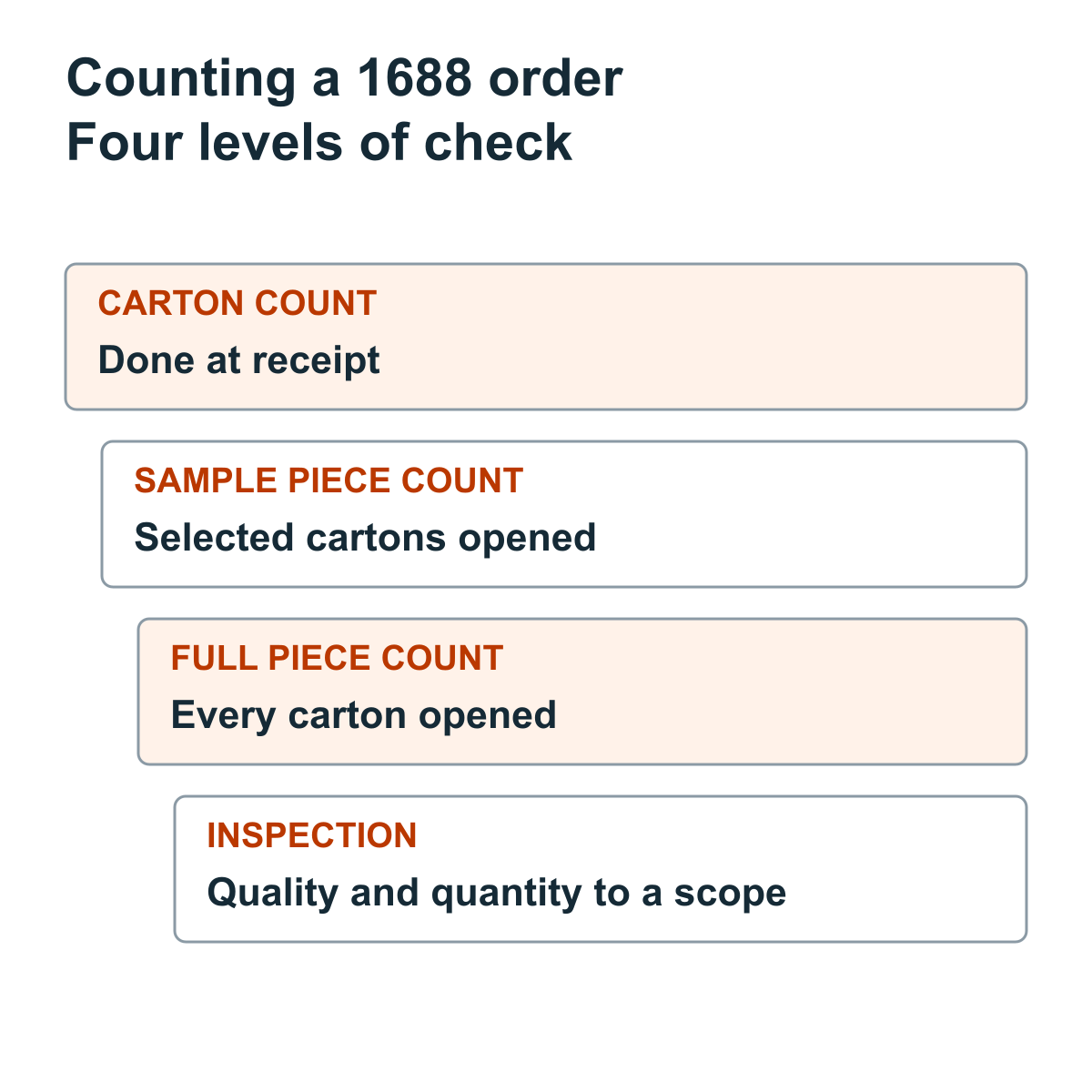
| Check | What it confirms | What it does not confirm |
|---|---|---|
| Carton count at receipt | The expected cartons arrived | How many units are inside |
| Sample piece count | Units in the cartons opened | Units in unopened cartons |
| Full piece count | Units in every carton | That each unit works or meets a specification |
| Pre-shipment inspection | Agreed quality, quantity, marking and packing points | Anything outside its written scope |
What receiving counts
When a parcel arrives, the warehouse matches it to your reference and counts the cartons or parcels against your receiving list: three expected, three received. It records the outside condition and the carton marks. That count shows that the right boxes arrived, not what is inside them.
A carton count is fast and does not disturb the seller’s packing. It catches a missing carton, which is the most common shortfall in a split dispatch.
What a piece count adds, and what it costs
A piece count opens each carton and counts the units, sometimes opening inner bags or retail boxes. It proves the quantity inside each carton at that time. It takes more handling time, can disturb the seller’s packing and may need the goods repacked afterward.
Inspection firms list quantity among the things a pre-shipment inspection verifies, together with quality, marking and packing. A warehouse piece count is a narrower check: it confirms numbers, not whether each unit works or meets a specification.
When a full count is worth asking for
Ask for a piece count when the quantity is the main risk: small high-value items, a seller with a history of short shipments, or an order where the units will be split across several destinations and each needs an exact number.
For large quantities of low-value goods, a sample count of a few cartons is often enough to show whether the seller packed to the stated quantity. Agree the sample size in writing so the result means something.
What to send with the request
Give the expected quantity per carton and per SKU from the seller’s packing list, how inner packs are made up (for example 10 units per bag) and whether retail boxes may be opened. Without the expected numbers, a count has nothing to be compared with.
Ask for the result as a table by carton and SKU, with a photo of any carton that is short or over. Keep that table with the release decision.
How our photo checks and counts are scoped
Visible photo checks show carton labels, outside condition and the items you asked to see. A full piece count, opening sealed inner units or testing functions is separately agreed and listed as its own service on the warehouse charge sheet.
Request the count before you approve repacking, so the numbers are taken from the seller’s original cartons.
Scope a count for one supplier
Suppose a seller ships 4 cartons that should each hold 120 phone cases in 12 bags of 10. The previous order from this seller arrived 30 units short.
- Send the expected numbers: 4 cartons, 12 bags per carton, 10 cases per bag, 480 cases in total.
- Ask for a full count of bags in every carton and a unit count of two bags per carton, with a photo of any bag that is short.
- Approve repacking only after the count table is back, and keep it with the release record.
You get a defined check that answers the specific risk with this seller, rather than an open request to “check everything”.
Put this into your request
Plan warehouse receiving using your actual goods, destination and known shipment details. Our team can review the missing information and the next step.
Common questions
The seller’s packing list says 500 units. Does receiving confirm that?
No. Receiving confirms the cartons. Ask for a piece count, or a sample count, if you need the units confirmed.
Will counting damage the seller’s packing?
It can. Opened inner bags and retail boxes may need repacking afterward. Say which packaging may be opened and ask how it will be closed again.
References
Sources checked for this edition on 12 November 2026. Service offers and carrier rules can change; confirm the terms for the shipment you intend to send.
