
Is It Cheaper to Ship Several 1688 Parcels Together?
See when combining several 1688 parcels at a China warehouse lowers the chargeable weight, when it does not, and what waiting for every seller costs.
The short answer
Often, but not always. Combining parcels can remove repeated minimum charges and rounding, and repacking can cut empty space. It can also make one large box whose volumetric weight is higher than the parcels’ actual weights, and waiting for a late seller adds storage time. Compare the chargeable weight both ways before deciding.
In this article
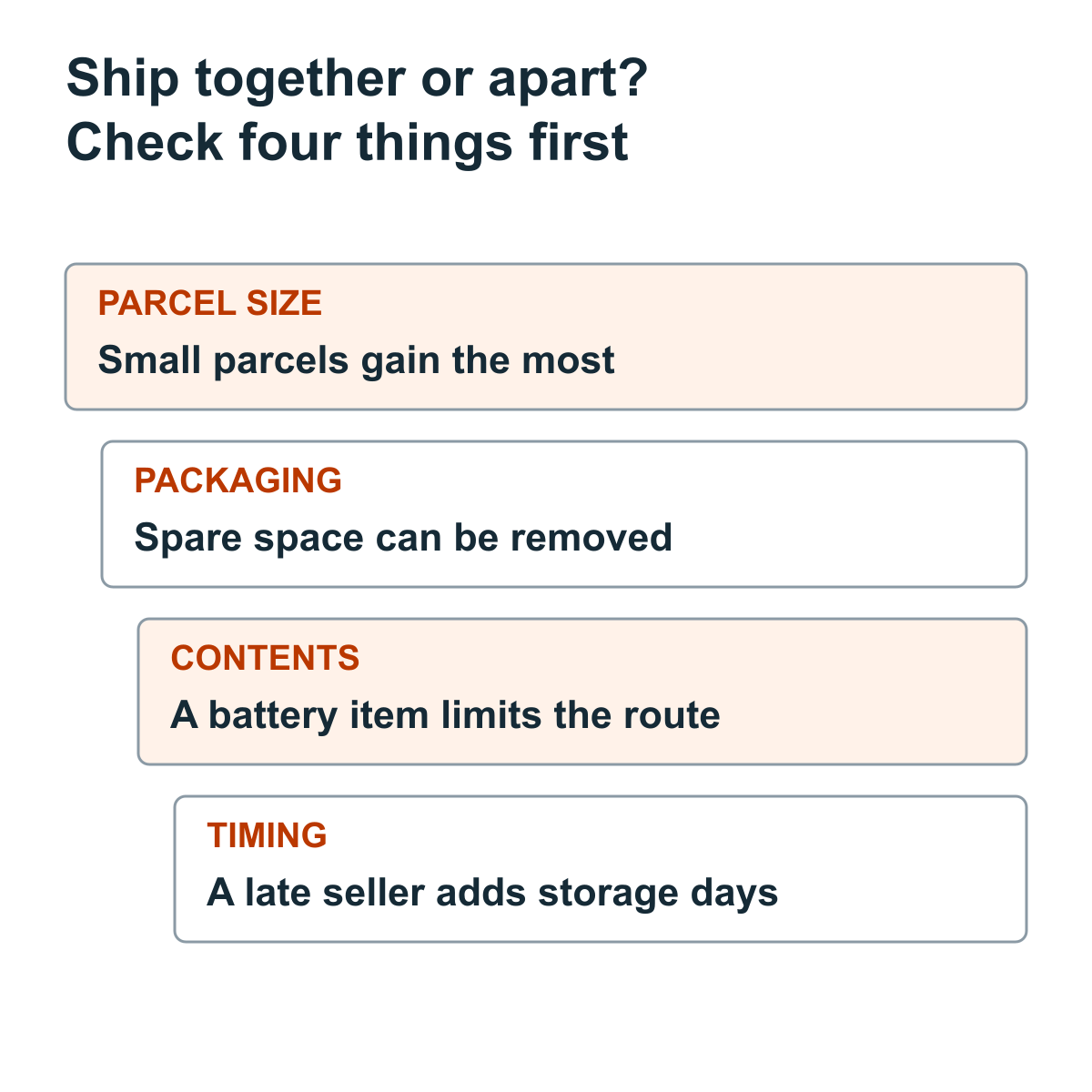
| Factor | Favors combining | Favors shipping separately |
|---|---|---|
| Parcel size | Several small, light parcels | One parcel already large |
| Packaging | Boxes with spare space | Goods that need their own boxes |
| Contents | All general goods | One item restricts the route |
| Timing | Sellers arrive close together | A seller is days behind |
Where the saving comes from
Many parcel services charge each parcel from a minimum weight and round its weight up to a step, such as the next half kilogram. Three small parcels each pay that minimum and that rounding; one combined parcel pays it once. The saving is largest when the parcels are small and light.
Repacking can add to it. Several sellers’ boxes often contain air, retail packaging or protective material the goods do not need for the onward trip. Removing some of it reduces the size of the combined parcel, and therefore its volumetric weight.
A worked example with rounding only
Assume three parcels weighing 1.2 kg, 1.3 kg and 1.1 kg, a service that rounds each parcel up to the next 0.5 kg, and that volumetric weight does not apply. Sent separately they are charged as 1.5 + 1.5 + 1.5 = 4.5 kg. Combined into one parcel of 3.6 kg, they are charged as 4.0 kg.
That 0.5 kg difference is the effect of rounding alone. Minimum charges per parcel, if the service has them, would widen the gap. The example uses no prices because the step size and the minimum are set by the service you are quoted.
When combining does not help
If the combined box is large and light, its volumetric weight can exceed the actual weight of all three parcels together. At an illustrative divisor of 5,000, a 60 × 40 × 40 cm box has a volumetric weight of 19.2 kg, far above the 3.6 kg of goods inside. A tighter repack, or two smaller boxes, may be cheaper.
Some goods should not be combined: a battery item can limit the route for everything packed with it, and fragile goods may need their original boxes. Ask for both options when a combined parcel would carry a restricted item.
Waiting for every seller has a cost
Combining means holding the first arrivals until the last one comes in. This site’s charge sheet lists 7 free storage days and USD 0.10 per kg per day for small parcels after that. A seller who ships a week late can turn a small rounding saving into a storage charge.
Compare the earliest storage deadline with the slowest seller’s delivery estimate. If the late parcel would push the batch past the free period, ask for a partial release of the parcels that are already in.
How our receiving request handles the choice
Tell us which parcels you expect and whether you want them held for one shipment. As they arrive, each one is recorded, and you can ask for the combined and separate chargeable weights before approving any repacking.
You approve the packing and the release; nothing is combined or repacked without that approval.
Decide whether to wait for the last seller
Suppose two sellers’ parcels, 1.2 kg and 1.3 kg, arrived on day 2. The third seller’s 1.1 kg parcel is expected on day 12. The warehouse confirms the free storage period starts on arrival.
- Calculate the rounding effect: shipping the two now and the third later is 1.5 + 1.5 + 1.5 = 4.5 kg; waiting and combining is 4.0 kg, assuming a 0.5 kg step and no volumetric weight.
- Calculate the storage effect: the first two parcels would be held three days past the 7 free days. At USD 0.10 per kg per day on 2.5 kg, that is about USD 0.75 under this site’s charge sheet, before any other charges.
- Ask for the actual service step, minimum charge and combined box size, then choose: wait and combine, or ship the two now.
You compare a measured weight saving against a measured storage cost instead of assuming that combining always wins.
Put this into your request
Plan warehouse receiving using your actual goods, destination and known shipment details. Our team can review the missing information and the next step.
Common questions
Does combining always lower the shipping cost?
No. It removes repeated minimums and rounding, but a large, light combined box can be charged on volumetric weight. Compare both chargeable weights first.
Can I combine some parcels and send the rest later?
Yes. Ask for a partial release of the parcels already received and keep a pending row for each one still on its way.
References
Sources checked for this edition on 12 November 2026. Service offers and carrier rules can change; confirm the terms for the shipment you intend to send.
