Gross, Net and Tare Weight: Which One Does the Warehouse Record?
Understand gross, net and tare weight on 1688 receiving and packing records, which one drives shipping charges and why the numbers change after repacking.
By 1688 Warehousing · · 4 min read
The short answer
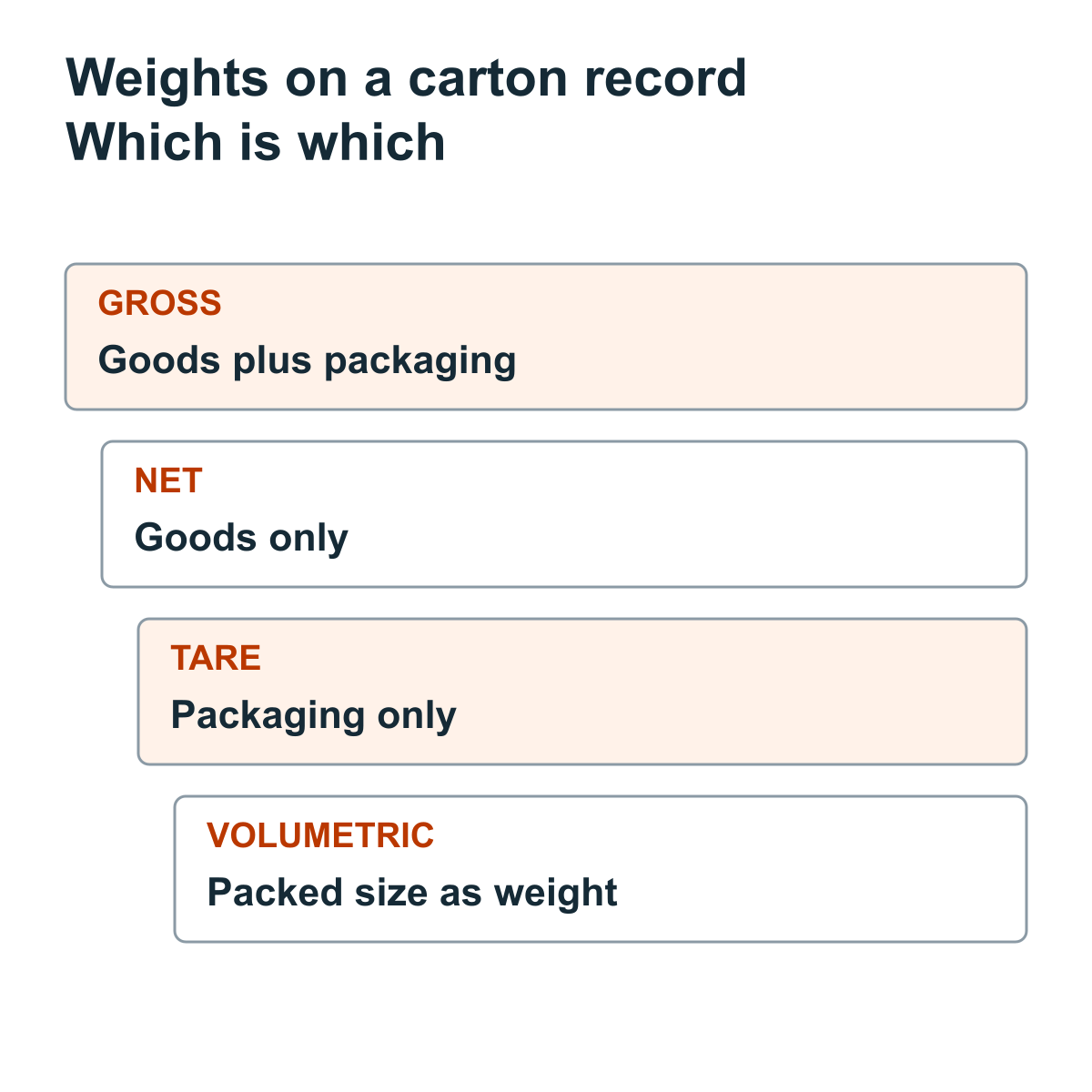
Gross weight is the goods plus all packaging; net weight is the goods alone; tare weight is the packaging, pallet or container on its own. A warehouse weighs cartons as they are, so its records show gross weight, and shipping charges are based on gross or volumetric weight. Net weight comes from the product details and is what customs declarations ask for per item.
In this articleDefinitions follow Maersk’s shipping weight guide. Charges use the measured gross or volumetric weight; declarations use net weight per item. Open the full-size diagram
Gross, Net and Tare Weight: Which One Does the Warehouse Record?: decision summary
Weight
What it includes
Where it is used
Gross
Goods plus all packaging
Warehouse records, shipping charges
Net
Goods only
Customs declaration item lines
Tare
Packaging, pallet or container only
Working out net from gross; container weights
Volumetric
Packed size converted to weight
Compared with gross to set the chargeable weight
Three weights, one carton
Maersk defines tare weight as the weight of empty packaging, a container or a pallet; net weight as the products only; and gross weight as the total of the two. A carton holding 10 kg of goods in 1.2 kg of box and padding has a net weight of 10 kg, a tare of 1.2 kg and a gross weight of 11.2 kg.
The same terms scale up. Maersk gives the tare of a standard 20ft container as 2,280 kg and a 40ft as about 3,700 kg; a full container’s gross weight includes all of that.
What the warehouse records
On receipt, a carton is weighed as it arrives, so the arrival record shows its gross weight. After repacking, the new cartons are weighed again, and that packed gross weight, with the dimensions, is what the onward quote uses.
The warehouse does not usually know the net weight of your goods unless it counts and weighs the items themselves. Take net weight from the seller’s product details or packing list.
Which weight drives which charge
Shipping charges start from gross weight, or volumetric weight if that is higher. Warehouse handling charges on our published schedule are by chargeable kilogram, and small-parcel storage is by kilogram per day.
Customs declarations ask for the net weight of each item line. Keep the two separate: a declaration that copies the gross carton weight into the item lines overstates the goods.
Why the numbers change after repacking
Removing excess outer boxes lowers tare and therefore gross weight; adding protective packing raises it. Volumetric weight usually changes more than actual weight, because repacking mainly changes the box size.
Ask for the before and after gross weights and dimensions together, so you can see what the repack actually changed.
How our records show weights
Receiving and packing records list measured gross weights and outside dimensions per carton. When you need net weights for a declaration, provide them from the product information or ask for a count and weighing of items as a separately agreed check.
Keep both on your own record so the declaration and the shipping quote can each use the right number.
Fill in weights for one carton
Suppose a carton arrives weighing 11.2 kg. The seller’s listing says each of the 20 items weighs 0.5 kg.
Record 11.2 kg as the gross weight from the warehouse record.
Work out the net weight from the listing: 20 × 0.5 kg = 10 kg, which goes on the declaration item line.
The difference, 1.2 kg, is the packaging; if repacking removes the outer box, ask for the new gross weight after packing.
The declaration uses the net weight, the shipping quote uses the measured gross or volumetric weight, and neither borrows the other’s number.
Put this into your request
Plan warehouse receiving using your actual goods, destination and known shipment details. Our team can review the missing information and the next step.
Sources checked for this edition on 12 November 2026. Service offers and carrier rules can change; confirm the terms for the shipment you intend to send.
What a China warehouse records when a 1688 parcel arrives damaged, what evidence the seller will ask for and how to choose between holding and shipping.
Compare a China receiving warehouse for 1688 orders with a third-party logistics (3PL) provider, what each one does and which you need for your business.
Learn the difference between a courier delivery to a China warehouse, a recorded arrival and goods ready to ship, and what to check at each 1688 stage.
Learn what goes into a China warehouse receiving address for 1688 sellers, where your reference belongs and what to check before the seller dispatches.
Work out storage charges for 1688 goods held in a China warehouse: the free period, the small-parcel and large-cargo rates on our schedule, and examples.
Learn what cross-docking is, how a 1688 receiving batch can be released with little or no storage time and what has to be decided before the goods arrive.
Learn what dock-to-stock time is, why 1688 shipments are often slow to go on sale at a destination warehouse and how China receiving records shorten it.
Learn what prep and kitting mean, where bundling, bagging and labeling of 1688 products is usually done, and what to ask the supplier or warehouse to do.
Understand US country of origin marking for goods bought on 1688: where the mark must be, what happens if it is missing and what to agree with the supplier.
Choose pallets for exporting 1688 goods: stringer or block, wood or plastic, why raw-wood pallets need ISPM 15 treatment and what to agree before palletizing.
See how a China warehouse can split one 1688 batch into shipments for several addresses, what changes when it does and how to write the split instruction.
Learn what a SKU is, why each color and size of a 1688 product needs its own and how a clear SKU list helps a China warehouse receive and check your order.
Learn what an SSCC logistics label is, when a retailer or 3PL may require one on cartons of 1688 goods and how it links each carton to the advance notice.