Can One 1688 Warehouse Batch Ship to Several Addresses?
See how a China warehouse can split one 1688 batch into shipments for several addresses, what changes when it does and how to write the split instruction.
By 1688 Warehousing · · 4 min read
The short answer
Yes. Received goods can be divided into separate outgoing shipments, each packed and labeled for its own address. Each shipment is then priced on its own, so per-shipment charges, minimums and any remote-area or address surcharges apply to every one. Give the warehouse a written split by carton or SKU and the full address for each shipment.
In this articleExplanatory sequence. Per-shipment charges and minimums are set by the carrier and the published warehouse schedule. Open the full-size diagram
Can One 1688 Warehouse Batch Ship to Several Addresses?: decision summary
Decision
One shipment
Several shipments
Carrier charges
One set
One set per shipment
Per-shipment surcharges
Applied once
Can apply to each
Warehouse packing
One pack
Packing per shipment
Delivery at destination
Redistribute yourself
Delivered to each address
How a split works
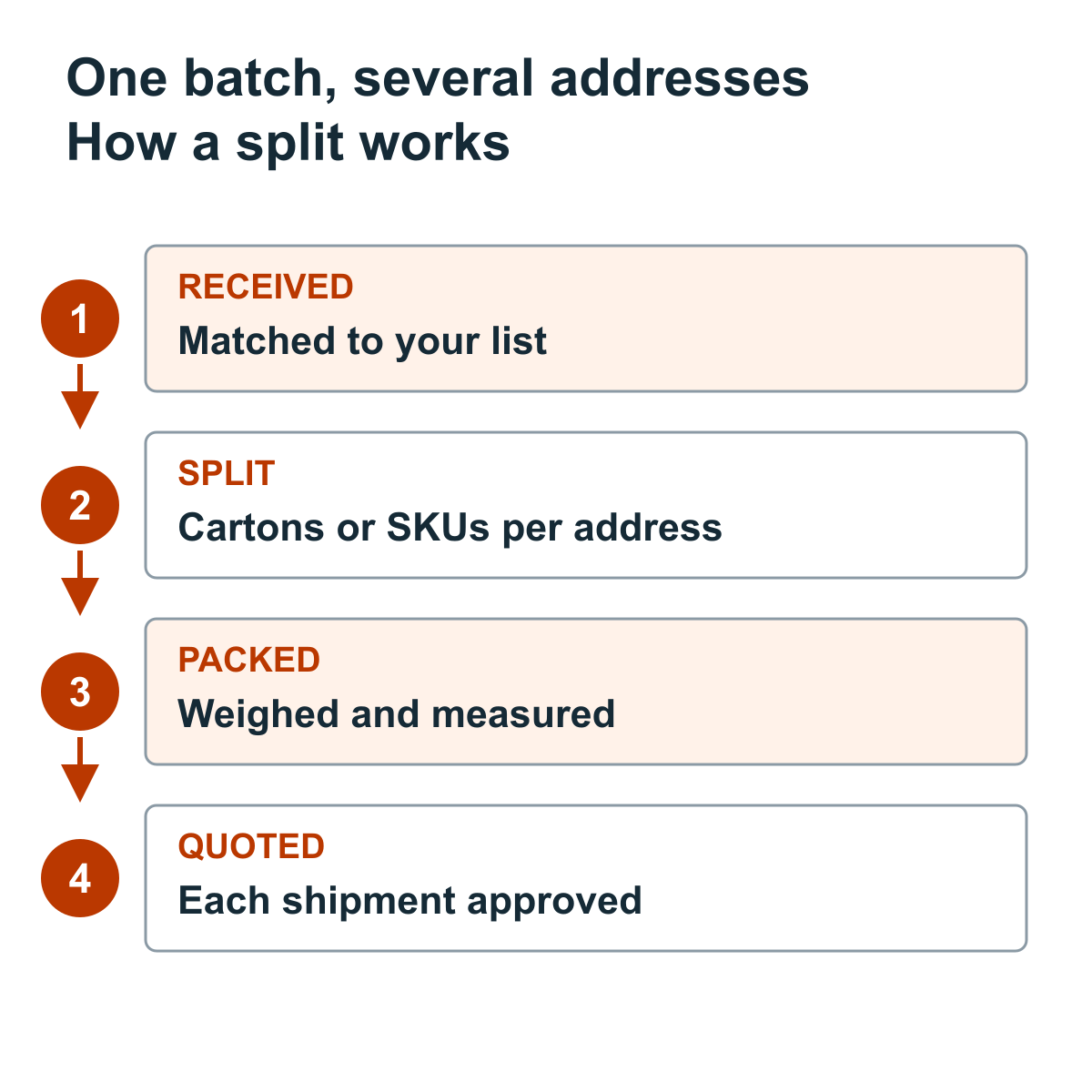
Once your parcels from different 1688 sellers are received and matched, the warehouse can pack them into separate outgoing shipments instead of one. Each shipment gets its own contents list, packed weight and dimensions, and later its own label and tracking number.
The split is decided by you: which cartons or SKUs go to which address. The warehouse needs that instruction before it packs, because repacking afterward is extra work.
What changes in the cost
Carrier charges are mostly per shipment. Express services price each shipment from its own weight steps, and surcharges such as remote area delivery and address correction are applied per shipment on DHL Express’s published list. Three shipments carry three sets of those charges.
Warehouse work also multiplies: each shipment needs packing and labeling. Our published schedule lists handling and packing charges and an order minimum; ask how they apply when one batch becomes several outgoing shipments.
When a split is worth it
Splitting saves a second domestic delivery in the destination country when the goods are going to different people or businesses anyway: samples to several customers, stock to two shops, gifts to family. Shipping everything to one address and redistributing locally can cost more and take longer.
It is less useful when the addresses are close together or the shipments would be very small, because per-shipment minimums then dominate.
Write the split instruction clearly
List each outgoing shipment with its recipient, full address, postal code and phone number, and the exact cartons or SKU quantities that go in it. Say whether items may be repacked together and whether retail boxes must stay intact.
If one SKU is divided between shipments, give the quantity per shipment, and ask for a count when the split is made. A split by quantity without a count is the most common source of a later dispute.
How our receiving request handles splits
Your receiving list records what arrived. When you are ready to release, send the split as part of the release instruction; the team confirms the packing and charges for each outgoing shipment before work starts.
Each shipment then gets its own measurements for the onward quote, so you approve each one separately.
Split one batch for three recipients
Suppose a batch of 60 phone cases and 30 chargers has arrived from two 1688 sellers, and you want 20 cases and 10 chargers sent to each of three shop addresses.
Write three shipments, each with the shop’s full address, postal code and phone, and 20 cases plus 10 chargers.
Ask for the count to be recorded per shipment when packing, and for each shipment’s packed weight and size.
Compare the three onward quotes with one shipment to a single address plus local redistribution, then approve.
You can see the real cost of delivering to three places directly before any goods move. The example has no prices; the quotes provide them.
Put this into your request
Plan warehouse receiving using your actual goods, destination and known shipment details. Our team can review the missing information and the next step.
Sources checked for this edition on 12 November 2026. Service offers and carrier rules can change; confirm the terms for the shipment you intend to send.
What a China warehouse records when a 1688 parcel arrives damaged, what evidence the seller will ask for and how to choose between holding and shipping.
Compare a China receiving warehouse for 1688 orders with a third-party logistics (3PL) provider, what each one does and which you need for your business.
Learn the difference between a courier delivery to a China warehouse, a recorded arrival and goods ready to ship, and what to check at each 1688 stage.
Learn what goes into a China warehouse receiving address for 1688 sellers, where your reference belongs and what to check before the seller dispatches.
Work out storage charges for 1688 goods held in a China warehouse: the free period, the small-parcel and large-cargo rates on our schedule, and examples.
Learn what cross-docking is, how a 1688 receiving batch can be released with little or no storage time and what has to be decided before the goods arrive.
Learn what dock-to-stock time is, why 1688 shipments are often slow to go on sale at a destination warehouse and how China receiving records shorten it.
Understand gross, net and tare weight on 1688 receiving and packing records, which one drives shipping charges and why the numbers change after repacking.
Learn what prep and kitting mean, where bundling, bagging and labeling of 1688 products is usually done, and what to ask the supplier or warehouse to do.
Understand US country of origin marking for goods bought on 1688: where the mark must be, what happens if it is missing and what to agree with the supplier.
Choose pallets for exporting 1688 goods: stringer or block, wood or plastic, why raw-wood pallets need ISPM 15 treatment and what to agree before palletizing.
Learn what a SKU is, why each color and size of a 1688 product needs its own and how a clear SKU list helps a China warehouse receive and check your order.
Learn what an SSCC logistics label is, when a retailer or 3PL may require one on cartons of 1688 goods and how it links each carton to the advance notice.