Choose pallets for exporting 1688 goods: stringer or block, wood or plastic, why raw-wood pallets need ISPM 15 treatment and what to agree before palletizing.
By 1688 Warehousing · · 4 min read
The short answer
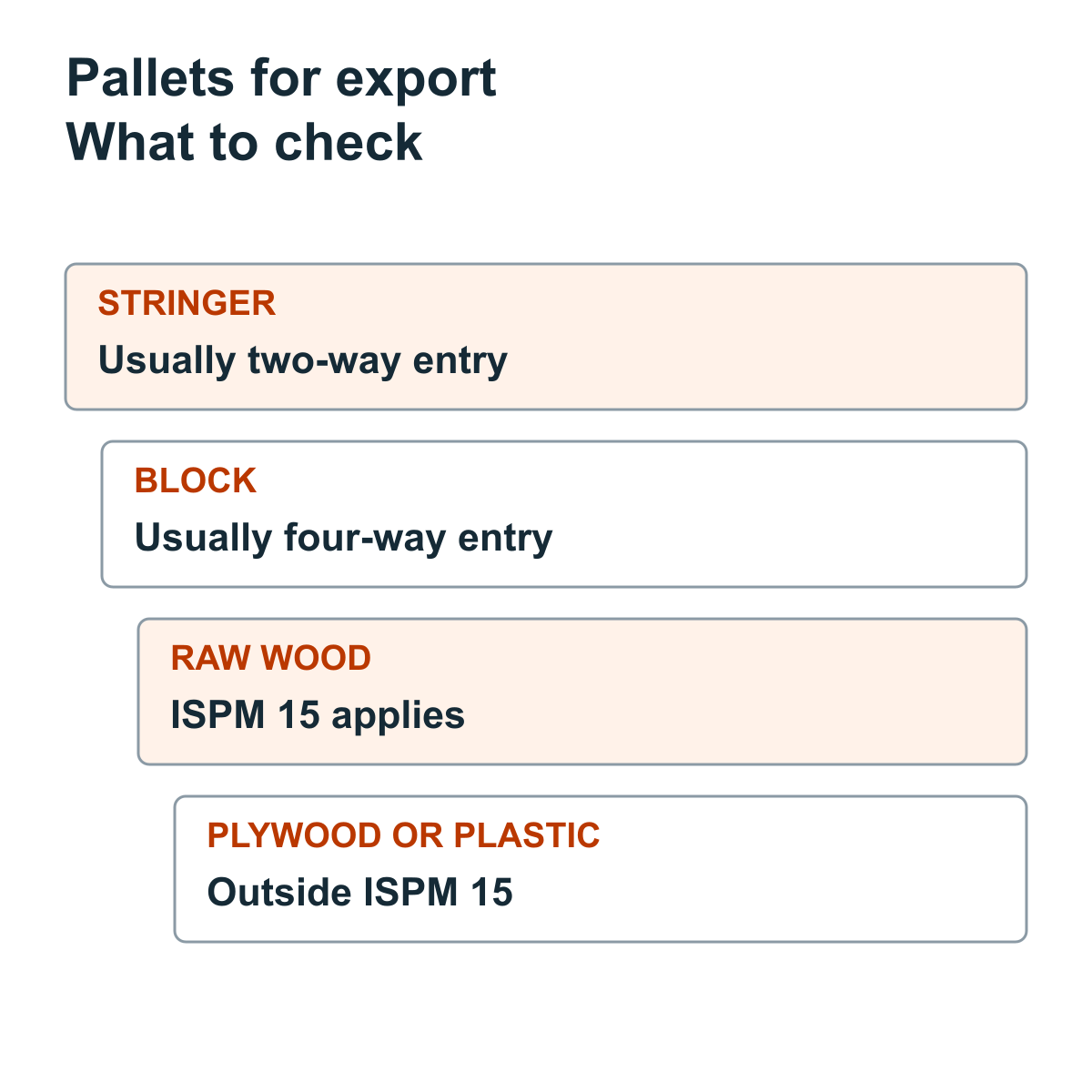
It depends on the cargo and destination. Block pallets can usually be lifted from all four sides, stringer pallets from two. If the pallet or any dunnage is made of raw wood, it falls under ISPM 15, the international standard for wood packaging, and international shipments often need it heat-treated and marked. Plastic, metal or processed wood such as plywood is outside that standard. Agree the pallet type before goods are palletized.
In this articleBased on Flexport’s glossary entry and the IPPC’s description of ISPM 15. Destination rules decide what is accepted. Open the full-size diagram
What Pallets Should 1688 Goods Be Shipped On?: decision summary
Pallet
Handling
ISPM 15
Raw-wood stringer
Usually two-way forklift entry
Applies; treatment often needed
Raw-wood block
Usually four-way entry
Applies; treatment often needed
Plywood or processed wood
Depends on design
Excluded as pest-free processed wood
Plastic or metal
Depends on design
Not wood packaging
Stringer or block
Flexport explains that stringer pallets use parallel boards under the deck and are usually entered by forklifts from two sides, while block pallets use blocks between the deck boards and can usually be entered from all four sides by forklifts and pallet jacks.
If your destination warehouse moves pallets with hand jacks, four-way entry makes handling easier.
Wood packaging and ISPM 15
ISPM 15, adopted under the International Plant Protection Convention, sets phytosanitary measures to reduce the risk of spreading pests through wood packaging made from raw wood in international trade. It covers dunnage as well as pallets and crates.
Flexport notes that international shipments often need heat-treated wood to meet ISPM 15. An untreated raw-wood pallet can cause a shipment to be held or the packaging to be treated or destroyed at destination.
What is outside the standard
IPPC notes that ISPM 15 excludes wood packaging made from wood processed so that it is free from pests, such as plywood. Plastic and metal pallets are not wood packaging at all.
Plastic or processed-wood pallets avoid the wood treatment question but cost more and may not suit very heavy loads. Choose by weight, destination and cost.
Weight and stack height
Flexport advises matching the pallet to cargo weight, carrier requirements and destination, and planning for stack height limits set by carriers and warehouses. Overhanging cartons get crushed; cartons should sit within the pallet’s edges.
Tell your destination warehouse or 3PL the pallet type and height before shipping, since some set their own limits.
How palletizing fits with receiving
Our published schedule covers receiving, storage, checks and packing. If your shipment needs palletizing, ask the team what pallet types are available and whether raw-wood pallets are heat-treated and marked before relying on it.
For LCL, the consolidator may palletize at its CFS; ask what it uses.
Choose pallets for a mixed export
Suppose 30 cartons from several 1688 sellers will be palletized for an LCL shipment to a 3PL that uses pallet jacks.
Ask the 3PL its pallet size, type and height limits.
Ask the warehouse or consolidator for block pallets that meet those limits and whether raw-wood pallets are heat-treated and marked.
Ask for cartons to sit within the pallet edges and for a photo of each finished pallet.
The pallets can be handled at the 3PL, will not be held over wood treatment, and arrive without crushed overhanging cartons.
Put this into your request
Plan warehouse receiving using your actual goods, destination and known shipment details. Our team can review the missing information and the next step.
Sources checked for this edition on 12 November 2026. Service offers and carrier rules can change; confirm the terms for the shipment you intend to send.
What a China warehouse records when a 1688 parcel arrives damaged, what evidence the seller will ask for and how to choose between holding and shipping.
Compare a China receiving warehouse for 1688 orders with a third-party logistics (3PL) provider, what each one does and which you need for your business.
Learn the difference between a courier delivery to a China warehouse, a recorded arrival and goods ready to ship, and what to check at each 1688 stage.
Learn what goes into a China warehouse receiving address for 1688 sellers, where your reference belongs and what to check before the seller dispatches.
Work out storage charges for 1688 goods held in a China warehouse: the free period, the small-parcel and large-cargo rates on our schedule, and examples.
Learn what cross-docking is, how a 1688 receiving batch can be released with little or no storage time and what has to be decided before the goods arrive.
Learn what dock-to-stock time is, why 1688 shipments are often slow to go on sale at a destination warehouse and how China receiving records shorten it.
Understand gross, net and tare weight on 1688 receiving and packing records, which one drives shipping charges and why the numbers change after repacking.
Learn what prep and kitting mean, where bundling, bagging and labeling of 1688 products is usually done, and what to ask the supplier or warehouse to do.
Understand US country of origin marking for goods bought on 1688: where the mark must be, what happens if it is missing and what to agree with the supplier.
See how a China warehouse can split one 1688 batch into shipments for several addresses, what changes when it does and how to write the split instruction.
Learn what a SKU is, why each color and size of a 1688 product needs its own and how a clear SKU list helps a China warehouse receive and check your order.
Learn what an SSCC logistics label is, when a retailer or 3PL may require one on cartons of 1688 goods and how it links each carton to the advance notice.