
Can 1688 Products Be Bundled or Prepped Before They Reach You?
Learn what prep and kitting mean, where bundling, bagging and labeling of 1688 products is usually done, and what to ask the supplier or warehouse to do.
The short answer
Yes, but decide where. Prep and kitting cover work on individual units: labeling, bagging, adding hangtags and bundling several SKUs into one kit. Flexport describes these as fulfillment-center services, often done to meet marketplace rules. For 1688 goods, the simplest options are asking the supplier to do it before dispatch or having a fulfillment provider do it at destination; ask a China receiving warehouse before assuming it offers it.
In this article
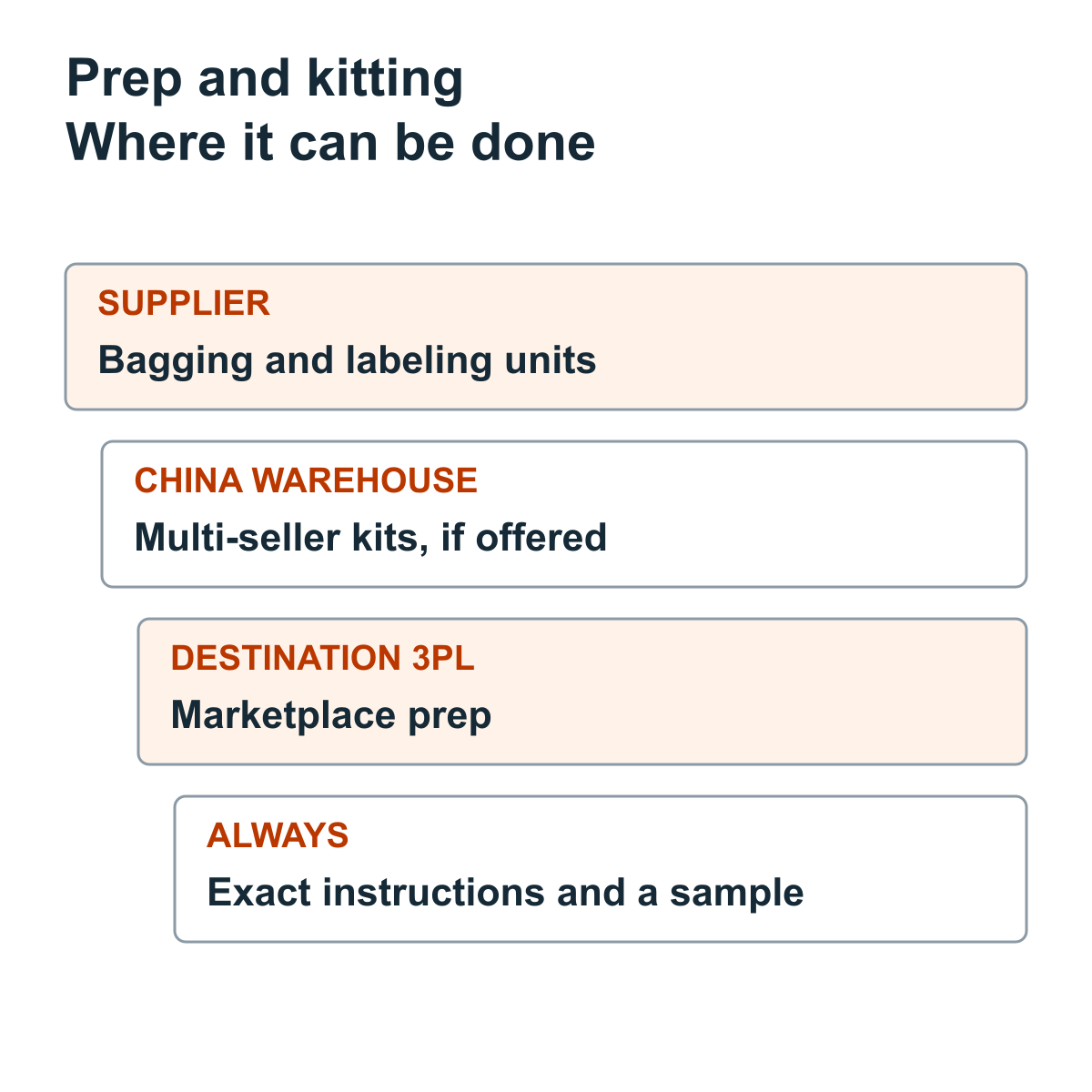
| Where | Good for | Watch out for |
|---|---|---|
| The 1688 supplier | Single-SKU bagging and labeling | Instructions must be exact; check a sample |
| Receiving warehouse in China | Kits from several sellers, if offered | Confirm the service and price first |
| Fulfillment provider at destination | Marketplace prep and changing kits | Per-unit charges at destination rates |
What prep and kitting mean
Flexport describes prep and kitting as work done on individual SKUs, such as bagging apparel, barcoding units, combining different SKUs into a kit, unloading containers and even embroidery. Common tasks include labeling, polybagging, hangtags and bundling several SKUs to sell as one item.
The aim is to get units into the exact form a store or marketplace expects, so they can go straight onto a shelf or listing.
Why sellers use it
Prep in a warehouse saves handling units yourself and helps meet marketplace rules, Flexport notes, such as the labeling and packaging requirements for Fulfillment by Amazon. Providers usually charge per unit or per task.
For kits made from several 1688 suppliers’ products, the components have to be in one place first, which is where a receiving or fulfillment warehouse comes in.
Three places it can be done
At the supplier: the cheapest place for single-SKU work like bagging and labeling, because the supplier handles every unit anyway. Send exact instructions and ask for a photo of a finished unit.
At a receiving warehouse in China: useful when kits combine products from different sellers, if the warehouse offers it. At a fulfillment provider in your market: common for marketplace prep, and easier to change later.
What to ask before choosing
Ask each option for a per-unit or per-task price, how quickly it can process your quantity, and what it needs from you: a kit list, label files, packaging materials. Ask how errors are handled, since a wrong kit is expensive to fix once it reaches a customer.
Our published warehouse schedule lists receiving, storage, photos, SKU checks, packing and repacking. Kitting and unit labeling are not on it, so ask the team before planning on them.
How our receiving records help
Whoever does the kitting needs to know exactly which units arrived. The receiving list and SKU checks show what came from each seller, which is the starting point for building kits.
If kits will be built at destination, send that provider the packed carton list from China so it can receive the components quickly.
Plan a gift-set kit from two sellers
Suppose you want to sell a gift set combining a mug from one 1688 seller and a coaster set from another, in a printed box from a third.
- Ask each seller to bag and label its own units before dispatch.
- Ask the receiving warehouse whether it can assemble kits and at what price; if not, ask your destination fulfillment provider.
- Send whoever assembles the kits a kit list, the box design and a photo of one finished set to match.
Each step happens where it is cheapest and possible, and nobody assumes a service that is not offered.
Put this into your request
Plan warehouse receiving using your actual goods, destination and known shipment details. Our team can review the missing information and the next step.
Common questions
Can I ask a 1688 seller to put my label on each unit?
Often yes, especially for bagging and labeling. Send the label file and placement, and ask for a photo before dispatch.
Is kitting the same as repacking?
No. Repacking changes cartons for shipping; kitting changes how units are combined for sale.
References
- Flexport glossary: prep and kitting services
- 1688 Warehousing: published handling and storage schedule
Sources checked for this edition on 12 November 2026. Service offers and carrier rules can change; confirm the terms for the shipment you intend to send.
