How Should You Set SKUs for 1688 Variants Before They Arrive?
Learn what a SKU is, why each color and size of a 1688 product needs its own and how a clear SKU list helps a China warehouse receive and check your order.
By 1688 Warehousing · · 4 min read
The short answer
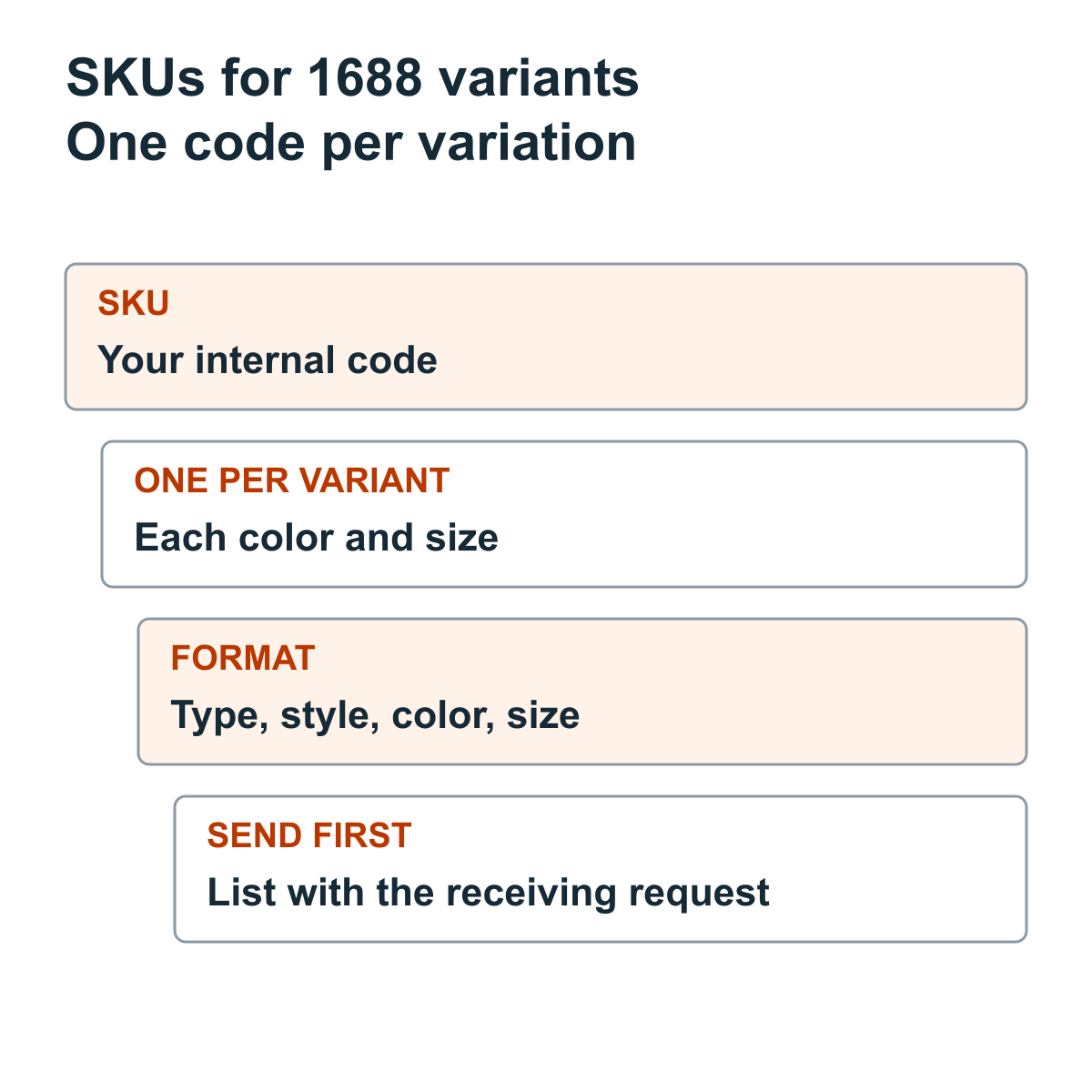
A SKU is your own internal code for each sellable variation of a product. Give every color, size or version its own SKU, build codes from short consistent segments, and send the list to the warehouse with your receiving request. Flexport notes warehouses use SKUs to locate stock, count inventory and pick orders; for 1688 orders, they are what lets variants be checked against what the sellers actually sent.
In this articleBased on Flexport’s glossary entry and GS1 US. SKU verification at the warehouse is a separately charged service on the published schedule. Open the full-size diagram
How Should You Set SKUs for 1688 Variants Before They Arrive?: decision summary
Field in your SKU list
Example
Why
SKU
MUG-CER-BLU-350
Your code for one sellable variant
Variant in English
Blue, 350 ml
For your records
Seller’s variant wording
As written on the listing
Lets the warehouse match the label
Expected quantity and seller
48, seller A
Lets receiving reconcile counts
What a SKU is
Flexport defines a SKU as a unique internal alphanumeric code used to identify and track specific products in an inventory system. Unlike a retail barcode number, it is merchant-specific, so you design it around attributes such as size, color and material.
GS1 US makes the same distinction: a GTIN is a universal number issued by GS1, while a SKU is a flexible code you create to track your own inventory.
One SKU per sellable variation
Merchants assign a SKU to every sellable variation, Flexport notes: a blue medium shirt and a red large shirt get different SKUs even though they are the same style.
1688 listings often put dozens of variants under one product page. If your order mixes them, each variant you bought needs its own SKU, or the warehouse cannot tell them apart in records.
A format that works
Flexport suggests building SKUs from short segments, such as product type, style, color and size, keeping the format consistent, never reusing a SKU for a different product and avoiding special characters that scanners or spreadsheets may misread.
For example, MUG-CER-BLU-350 for a 350 ml blue ceramic mug. Add the seller’s variant name in Chinese next to it in your list, so the warehouse can match it to the listing.
How the warehouse uses your list
With a SKU list, receiving can record quantities per variant, and a SKU check can confirm the colors and sizes against labels. Our published schedule lists detailed SKU verification as a separate service, charged per piece.
Without a list, the record can only say what cartons arrived, not which variants are inside.
Send the list before the goods arrive
Send the SKU list with your receiving request: SKU, product, variant in English and in the seller’s wording, expected quantity and which seller sends it. Update it if a seller substitutes or splits a variant.
Use the same SKUs later with your destination warehouse or marketplace, so the records match from China to sale.
Write a SKU list for a mixed order
Suppose you ordered T-shirts in 3 colors and 4 sizes from one 1688 seller, and tote bags in 2 colors from another.
Create 12 T-shirt SKUs and 2 tote bag SKUs, each from type, color and size segments.
Add the seller’s variant wording and the expected quantity next to each SKU.
Send the list with your receiving request, and ask for a SKU check of a few units per color when the goods arrive.
The warehouse can confirm that each variant arrived in the right quantity, and your records match from China to your store.
Put this into your request
Plan warehouse receiving using your actual goods, destination and known shipment details. Our team can review the missing information and the next step.
Sources checked for this edition on 12 November 2026. Service offers and carrier rules can change; confirm the terms for the shipment you intend to send.
What a China warehouse records when a 1688 parcel arrives damaged, what evidence the seller will ask for and how to choose between holding and shipping.
Compare a China receiving warehouse for 1688 orders with a third-party logistics (3PL) provider, what each one does and which you need for your business.
Learn the difference between a courier delivery to a China warehouse, a recorded arrival and goods ready to ship, and what to check at each 1688 stage.
Learn what goes into a China warehouse receiving address for 1688 sellers, where your reference belongs and what to check before the seller dispatches.
Work out storage charges for 1688 goods held in a China warehouse: the free period, the small-parcel and large-cargo rates on our schedule, and examples.
Learn what cross-docking is, how a 1688 receiving batch can be released with little or no storage time and what has to be decided before the goods arrive.
Learn what dock-to-stock time is, why 1688 shipments are often slow to go on sale at a destination warehouse and how China receiving records shorten it.
Understand gross, net and tare weight on 1688 receiving and packing records, which one drives shipping charges and why the numbers change after repacking.
Learn what prep and kitting mean, where bundling, bagging and labeling of 1688 products is usually done, and what to ask the supplier or warehouse to do.
Understand US country of origin marking for goods bought on 1688: where the mark must be, what happens if it is missing and what to agree with the supplier.
Choose pallets for exporting 1688 goods: stringer or block, wood or plastic, why raw-wood pallets need ISPM 15 treatment and what to agree before palletizing.
See how a China warehouse can split one 1688 batch into shipments for several addresses, what changes when it does and how to write the split instruction.
Learn what an SSCC logistics label is, when a retailer or 3PL may require one on cartons of 1688 goods and how it links each carton to the advance notice.