Do 1688 Goods Need a “Made in China” Mark for the US?
Understand US country of origin marking for goods bought on 1688: where the mark must be, what happens if it is missing and what to agree with the supplier.
By 1688 Warehousing · · 4 min read
The short answer
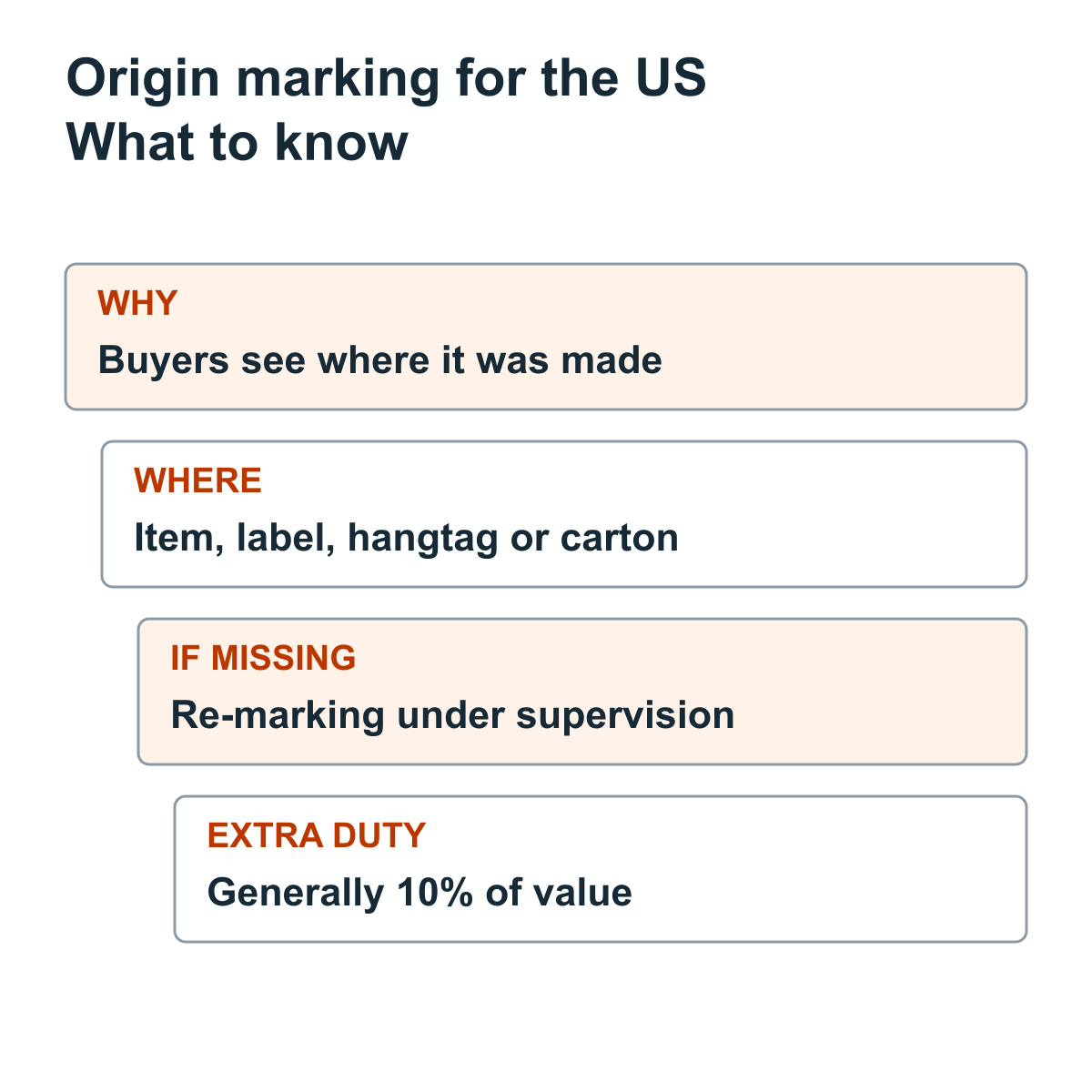
Generally yes, for goods imported into the US. Flexport explains that the item must be marked so the ultimate purchaser can see and read it easily, on the item itself or on a label, hangtag or the outer carton, with special rules for some items. If goods arrive unmarked, US Customs and Border Protection can require them to be marked under supervision and can assess an additional duty, generally 10% of the goods’ value.
In this articleSummary of Flexport’s glossary entry on US origin marking. CBP rules and exceptions govern each product. Open the full-size diagram
Do 1688 Goods Need a “Made in China” Mark for the US?: decision summary
Question
Answer for US imports
Is marking required?
Generally yes, so the ultimate purchaser knows the origin
Where?
On the item, a label, hangtag or outer carton the purchaser can see
If missing
CBP can require marking under supervision
Extra cost
An additional duty, generally 10% of the goods’ value
Best time to fix
Before production or packing in China
Why the mark is required
Flexport notes that country of origin marking exists to protect US consumers, so they know where the goods they buy were produced. For most 1688 products, the origin is China and the mark is a plain statement such as “Made in China”.
Other countries have their own origin labeling rules. This article covers the US requirement; check your destination’s rules if you import elsewhere.
Where the mark must be
The item must be marked in a way the ultimate purchaser can see and read easily, whether molded on the item, printed on a label or hangtag, or stated on the outer carton, according to Flexport. Specific rules apply to items that cannot be marked, are intended for repackaging or are imported for assembly.
The ultimate purchaser is usually the retail customer, so a mark only on a shipping carton that the customer never sees may not be enough for goods sold individually.
What happens if goods arrive unmarked
Flexport explains that CBP can require you to mark the goods, which may mean re-marking them under supervision, and can assess an additional duty, generally 10% of the goods’ value, on items that arrive unmarked.
That makes a missing mark expensive to fix at the destination. It is far cheaper to have the supplier add it before production or packing.
What to agree with the supplier
Flexport advises confirming the required wording and placement with your supplier before production. Send the exact wording and a photo or drawing showing where it should go, and ask for a photo of a finished, packed unit.
Many 1688 suppliers sell mainly in China and do not mark goods for export by default. Do not assume the mark is there.
How our receiving checks can help
When goods arrive at the receiving warehouse, you can request photos of the retail packaging or labels to confirm the mark is present before export. Our published schedule lists detailed photos and SKU checks as separate services.
If marks are missing, deciding whether to fix them in China, before the goods leave, is the moment to do it.
Make sure the mark is there before export
Suppose you are importing 500 kitchen gadgets from a 1688 supplier to sell individually in the US.
Send the supplier the wording “Made in China” and a drawing showing it on each retail box.
Ask for a photo of one packed retail box before the order ships.
When the goods reach the receiving warehouse, request a photo check of a few boxes to confirm the mark before release.
The goods leave China correctly marked, avoiding re-marking or the additional duty on arrival.
Put this into your request
Plan warehouse receiving using your actual goods, destination and known shipment details. Our team can review the missing information and the next step.
Is a “Made in China” sticker on the shipping carton enough?
Only if the carton is what the ultimate purchaser receives. For goods sold individually, the mark usually needs to be on the item or its retail packaging.
Does this apply to goods I keep for my own use?
Marking rules apply to imported goods generally, with specific exceptions. Ask a customs broker for your case.
Sources checked for this edition on 12 November 2026. Service offers and carrier rules can change; confirm the terms for the shipment you intend to send.
What a China warehouse records when a 1688 parcel arrives damaged, what evidence the seller will ask for and how to choose between holding and shipping.
Compare a China receiving warehouse for 1688 orders with a third-party logistics (3PL) provider, what each one does and which you need for your business.
Learn the difference between a courier delivery to a China warehouse, a recorded arrival and goods ready to ship, and what to check at each 1688 stage.
Learn what goes into a China warehouse receiving address for 1688 sellers, where your reference belongs and what to check before the seller dispatches.
Work out storage charges for 1688 goods held in a China warehouse: the free period, the small-parcel and large-cargo rates on our schedule, and examples.
Learn what cross-docking is, how a 1688 receiving batch can be released with little or no storage time and what has to be decided before the goods arrive.
Learn what dock-to-stock time is, why 1688 shipments are often slow to go on sale at a destination warehouse and how China receiving records shorten it.
Understand gross, net and tare weight on 1688 receiving and packing records, which one drives shipping charges and why the numbers change after repacking.
Learn what prep and kitting mean, where bundling, bagging and labeling of 1688 products is usually done, and what to ask the supplier or warehouse to do.
Choose pallets for exporting 1688 goods: stringer or block, wood or plastic, why raw-wood pallets need ISPM 15 treatment and what to agree before palletizing.
See how a China warehouse can split one 1688 batch into shipments for several addresses, what changes when it does and how to write the split instruction.
Learn what a SKU is, why each color and size of a 1688 product needs its own and how a clear SKU list helps a China warehouse receive and check your order.
Learn what an SSCC logistics label is, when a retailer or 3PL may require one on cartons of 1688 goods and how it links each carton to the advance notice.