
Do 1688 Products Need a GTIN Barcode Before You Resell Them?
Learn what a GTIN is, when a resold 1688 product needs one, why a factory’s existing barcode may not be yours to use and how a SKU differs.
The short answer
It depends on where you sell. A GTIN is the product number behind a retail barcode, issued by GS1 and assigned by the brand owner. Many retailers and marketplaces ask for one; GS1 US notes Amazon may allow exemptions for some private-label products but encourages GS1-issued GTINs. If you sell under your own brand, the GTIN should be yours, not the factory’s. A SKU is only your internal code.
In this article
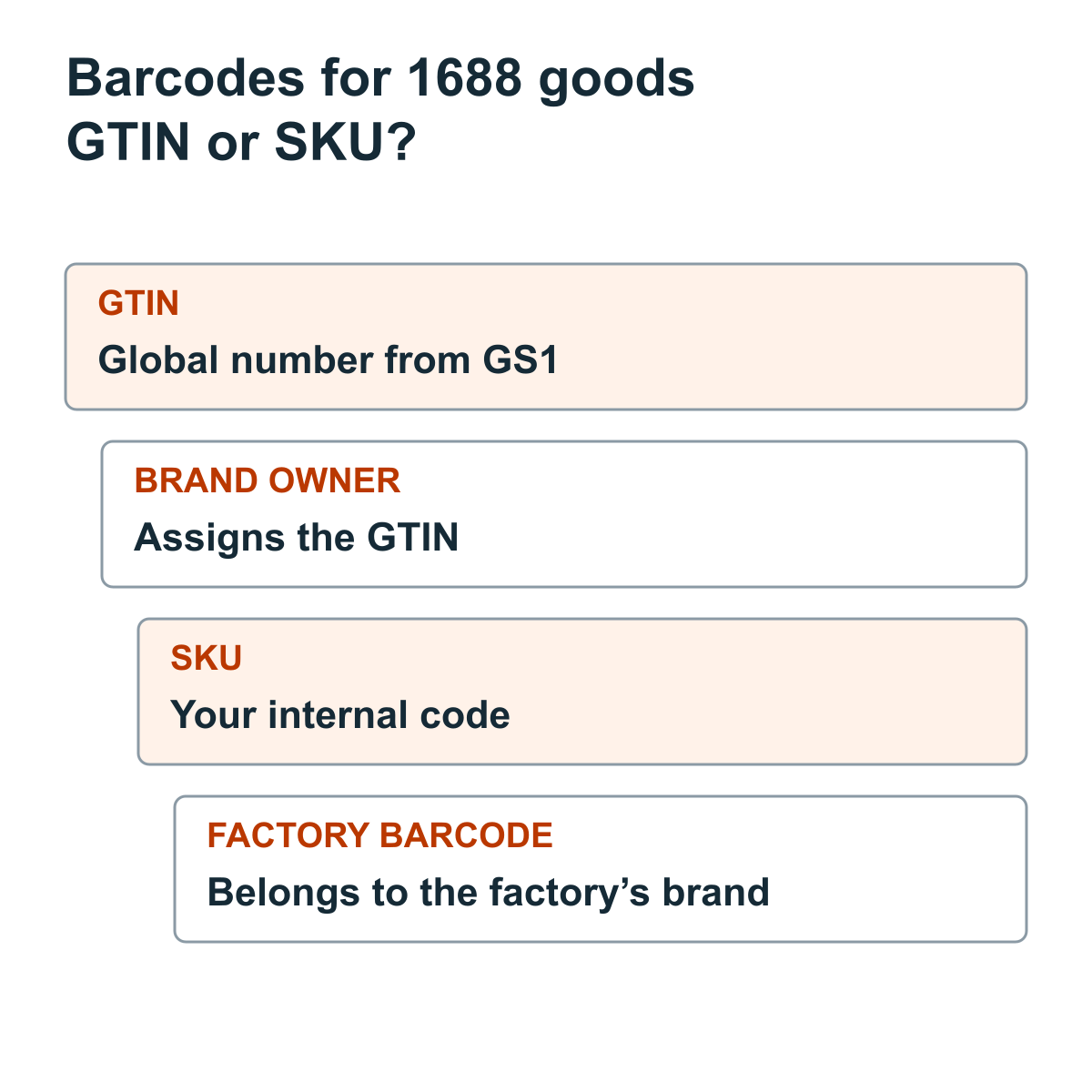
| Item | What it is | Who controls it |
|---|---|---|
| GTIN | Globally unique product number (8, 12, 13 or 14 digits) | Issued by GS1, assigned by the brand owner |
| Barcode | How the GTIN is printed for scanning | Printed on the product or packaging |
| SKU | Your internal stock code | You |
| Factory barcode | The factory’s own GTIN, if it is the brand | The factory as brand owner |
What a GTIN is
GS1 describes the Global Trade Item Number as the number a company uses to uniquely identify its trade items, products priced, ordered or invoiced anywhere in the supply chain. GTINs come in four structures, 8, 12, 13 or 14 digits long, all intended for global use.
It is the number encoded in the barcode scanned at a till or used to match a listing online. The barcode is how it is printed; the GTIN is what it identifies.
Who assigns it
GS1 US explains that the brand owner assigns the GTIN and marks the product with it. A GTIN is issued by GS1 and used by every retailer, distributor and marketplace to identify the same product.
A 1688 product may already carry a barcode. If it is the factory’s own brand, that number identifies the factory’s product. If you are selling under your own brand, you are the brand owner and should use your own GTINs.
GTIN versus SKU
GS1 US distinguishes the two: a GTIN is a universal, permanent number issued by GS1, while a SKU is a flexible code you create to track your own inventory. Two sellers of the same product share a GTIN but can have different SKUs.
For warehouse work in China, a SKU on each item or carton is often enough to keep variants apart. For selling, the GTIN is what retailers and marketplaces look up.
When you need one
You usually need GTINs if a retailer or marketplace asks for them, which many do. GS1 US notes that Amazon may grant exemptions for some private-label products but encourages GS1-issued GTINs, especially for brands planning to sell beyond one marketplace.
If you only use the goods yourself or sell where no barcode is needed, a GTIN is not required. Decide before production, because barcodes are cheapest to print on packaging at the factory.
Labeling 1688 goods before export
If your packaging carries your GTIN, ask the 1688 supplier to print or apply the barcode before dispatch, and check a sample. If labels must be applied after the goods arrive, ask the receiving warehouse whether it offers labeling and how it is charged before relying on it.
Give the warehouse your SKU and GTIN list so it can check variants against labels during receiving or a SKU check.
Plan barcodes for a private-label order
Suppose you are ordering 3 colors of a bottle under your own brand from a 1688 factory, to sell on a marketplace that asks for GTINs.
- Get one GTIN per color from GS1 in your country, because each variant is usually treated as a different trade item; confirm with GS1.
- Send the factory the barcode artwork for each color and ask for a photo of printed packaging before production.
- Give the receiving warehouse the SKU-to-GTIN list and ask for a SKU check of a few units per color on arrival.
Each variant carries your own number, the marketplace can match it, and the warehouse can confirm colors against labels before export.
Put this into your request
Plan warehouse receiving using your actual goods, destination and known shipment details. Our team can review the missing information and the next step.
Common questions
Can I use the barcode already on a 1688 product?
Only if you are reselling that brand’s product unchanged. If you sell it under your own brand, use your own GTIN.
Can I buy cheap barcodes from a reseller?
GS1 US says GTINs are issued exclusively by GS1. Check a marketplace’s rules before using numbers from another source.
References
Sources checked for this edition on 12 November 2026. Service offers and carrier rules can change; confirm the terms for the shipment you intend to send.
